
Certification Master~12 hours totalAll courses
DealerReady Certified
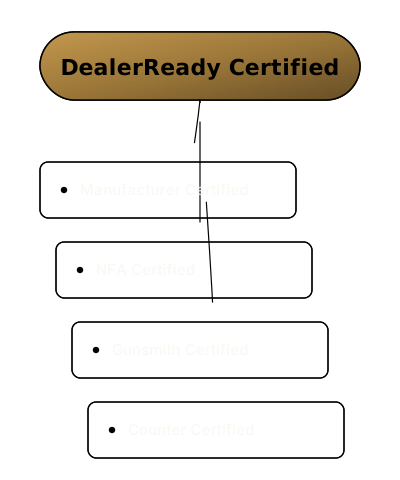
The master credential. Every course in the catalog.
$1200+ standalone · save $750+
Why this credential
What this certification actually defends.
DealerReady Certified is the credential for the person the rest of the team calls when something goes sideways. Counter Certified covers the daily Title I transfer at the register. DealerReady Certified covers everything else the license actually touches: the bound book an IOI tests every other record against, the interstate shipment that has to satisfy two states’ laws at once, the gunsmith intake that quietly crossed the manufacturing line, the Form 4 that has been pending for nine months, and the YHSA notice that has to be both posted and handed to the buyer. It is the full surface area of compliance for a Type 01, an 07, and an SOT operation under one credential.
The audit posture matters. An ATF Industry Operations Investigator does not test 4473s in isolation. They reconcile the bound book against physical inventory, tie out dispositions to 4473s, verify that multiple-sale and theft-loss filings line up, check marking and serialization on anything you manufactured, and look at your NFA registrations against the NFRTR. A holder of this credential can sit across from an IOI and answer every one of those threads from the same baseline the inspector is working from. That is the difference between a clean inspection and a willful-violation finding that costs you the license.
The insurance posture matters too. Carriers that write FFL liability and commercial crime coverage increasingly ask for evidence of training across the full compliance footprint, not just transfer screening. A documented credential that spans 4473s, straw recognition, YHSA, interstate, bound book, gunsmith threshold, manufacturing, and NFA gives the broker something concrete to point at during underwriting and at renewal. It also gives counsel a defensible answer if a transaction is ever litigated downstream.
And the owner peace of mind matters. Most shop owners cannot personally be on the floor for every shift. The point of this credential is that the person who is on shift can answer the rare question. A customer asks whether a pistol-to-SBR conversion can be done in the shop. A repeat buyer’s father is paying cash at the counter for the third long gun this month. A non-resident wants to walk out with a handgun. A small-batch contract comes in that crosses the 07 threshold. A trust customer asks why the CLEO has not signed off. The DealerReady Certified holder handles each of those without escalating to ownership, and documents the decision in a way that survives an inspection two years later.
Included courses
Every course, one per-employee price.
$1200+ standalone → $449 bundled
- 01
Every course in the catalog
Certification outline
The combined workflow, end to end.
Module 1
Intake at the Counter: 4473 Completion and Recordkeeping
- Form 4473 Revision 5300.9 from Section A through Section E without inspector-flagged errors.
- NICS workflow, response handling, and the three-business-day default-proceed window under 18 U.S.C. § 922(t).
- Correction discipline: line-through and initial versus full reprint.
- 20-year retention under 27 CFR § 478.129 and trace-request response timing.
Module 2
Buyer Screening and Straw Purchase Recognition
- Actual-buyer analysis under Abramski v. United States, 573 U.S. 169 (2014).
- Post-BSCA standalone straw statute at 18 U.S.C. § 932.
- Behavioral indicators, third-party payment, and pattern detection.
- Scripted refusal language, declined-sale documentation, and the incident report.
Module 3
Youth Handgun Safety Act and Posted-Notice Obligations
- 18 U.S.C. § 922(x) prohibition and 27 CFR § 478.103 notice requirements.
- Posting on premises and delivery with every handgun transfer to a non-licensee.
- Narrow exceptions and the parental-consent documentation that must travel with the juvenile.
- State minimum-age and handgun-transfer overlays that supersede the federal floor.
Module 4
Interstate Transfers and Shipping
- 18 U.S.C. § 922(b)(3) prohibition and the dual-compliance long-gun exception.
- Handguns to non-residents always FFL-to-FFL in the buyer’s state.
- ATF eZ Check verification and signed-license retention before shipment.
- USPS POM 432, common carrier notice under 922(e), and inheritance and repair-return exceptions.
Module 5
Bound Book Management and Inspection Readiness
- Required A&D fields under 27 CFR § 478.125(e) and the 7-day open-disposition rule.
- Electronic bound book criteria under ATF Ruling 2008–2 and required variance approval.
- Reconciliation against physical inventory, 4473 cross-reference, and 3310.4 and 3310.11 tie-outs.
- Theft and loss reporting within 48 hours under 27 CFR § 478.39a.
Module 6
Gunsmithing vs. Manufacturing: The 07 Threshold
- Dealer and manufacturer definitions under 18 U.S.C. § 921(a)(10) and § 921(a)(21)(A).
- ATF Ruling 2009–1 customer-ownership safe harbor; ATF Ruling 2010–10 production-for-distribution trigger.
- Receiver completion, blank builds, batch and repeat work that signal a manufacturing posture.
- Pistol-to-SBR conversions as NFA making events under 26 U.S.C. § 5822, outside gunsmith authority.
Module 7
Type 07 Manufacturing Obligations
- Marking and serialization under 27 CFR § 478.92, with variance procedure under ATF I 5300.4.
- Parallel A&D entries on raw receivers and finished firearms under § § 478.123 and 478.125.
- AFMER (ATF Form 5300.11) due April 1 each year, including zero-production cycles.
- FAET under 26 U.S.C. § 4181, filed quarterly on IRS Form 720 with TTB Form 5300.26 through TTB jurisdiction.
Module 8
NFA Forms and Form 4 Processing
- Title II categories, NFRTR registration under 26 U.S.C. § 5841, and the GCA-NFA interaction.
- Form 1, Form 3, Form 4, and Form 5 by purpose, tax treatment, and party eligibility.
- Rule 41F responsible-person requirements, fingerprints, photos, and CLEO notification as notice not approval.
- Pending-transfer custody, pickup workflow, 4473 at transfer, and bound book disposition.
Module 9
Export, Cross-Agency Coordination, and Federal Excise Tax
- 2020 ITAR-to-EAR transition and Commerce Control List jurisdiction for most commercial firearms.
- Remaining USML and DDTC items requiring State Department authorization.
- Coordinating ATF, TTB, and Commerce obligations on a single shipment.
- Audit-trigger patterns that surface across all three agencies.
Module 10
Inspection Defense and the IOI Visit
- What the Industry Operations Investigator pulls first and how to be ready for it.
- Reconciling A&D, 4473s, multiple-sale, theft and loss, NFA, and AFMER into one defensible narrative.
- Distinguishing inadvertent from willful-violation patterns and remediation between inspections.
- Acquisition and successor-licensee transitions, going-out-of-business surrender under 27 CFR § 478.127.
Who this is for
Built for the people on the line.
- Compliance officers responsible for the full compliance program at a single-location or multi-location FFL.
- Owner-operators who carry both the business and the regulatory exposure of the license.
- Multi-line shop managers running counter sales, gunsmithing, NFA, and shipping under one roof.
- Senior staff designated as the escalation point for rare or unusual transfer scenarios.
- Operations leads at Type 07 manufacturers coordinating across ATF, TTB, and Commerce obligations.
- FFL-association trainers and industry instructors building curricula for member dealers.
- Successor licensees and acquisition teams onboarding to an established FFL’s records and procedures.
At a glance
- Per-employee price
- $449
- Courses included
- All
- Total time
- ~12 hours
- Standalone value
- $1200+
- You save
- $750+
Key takeaways
Walk away able to run the role unsupervised.
- 01
Run any 4473 transaction from ID check through Section D signature, including delayed, denied, cancelled, and voided dispositions, without supervision.
- 02
Recognize and refuse a straw purchase under 18 U.S.C. § 922(a)(6) and § 932, document the incident, and decide whether to escalate to ATF or local law enforcement.
- 03
Maintain a bound book that an IOI can reconcile against physical inventory, 4473s, and federal filings without finding open dispositions, missing fields, or untraceable entries.
- 04
Decide correctly whether a piece of shop work is gunsmithing, manufacturing, or an NFA making event, and document the decision against ATF Ruling 2009–1, ATF Ruling 2010–10, or 26 U.S.C. § 5822.
- 05
Process a Form 4 transfer to an unlicensed individual or trust from intake through CLEO notification, pending custody, and 4473-at-pickup disposition.
- 06
Ship a long gun or handgun interstate under the right statutory authority, with the receiving FFL verified through ATF eZ Check and the signed license on file.
- 07
Calculate AFMER and FAET obligations on the right forms to the right agency on the right schedule, and recognize when an activity has crossed from Type 01 into Type 07 territory.
- 08
Deliver and post the YHSA notice in the prescribed text under 27 CFR § 478.103 and apply the parental-consent exception correctly when it applies.
- 09
Sit across from an ATF Industry Operations Investigator and answer questions about any record in the shop from the same baseline the inspector is working from.
Regulatory references
Everything this credential covers, by the book.
- 18 U.S.C. § 921(a)(10) and § 921(a)(21)(A)
- 18 U.S.C. § 921(a)(29)
- 18 U.S.C. § 922(a)(2), § 922(a)(3), and § 922(a)(5)
- 18 U.S.C. § 922(a)(6)
- 18 U.S.C. § 922(b)(3)
- 18 U.S.C. § 922(e) and § 922(f)
- 18 U.S.C. § 922(t)
- 18 U.S.C. § 922(x)
- 18 U.S.C. § 923 and § 923(g)
- 18 U.S.C. § 924(a)(2)
- 18 U.S.C. § 932 (Bipartisan Safer Communities Act of 2022)
- 26 U.S.C. § 4181 and § 6302 (Firearms and Ammunition Excise Tax)
- 26 U.S.C. §§ 5812, 5821, 5822, and 5841 (National Firearms Act)
- 27 CFR § 478.11 (definitions)
- 27 CFR §§ 478.29, 478.30, 478.31, and 478.99 (interstate and prohibited transfers)
- 27 CFR § 478.39a (theft and loss reporting)
- 27 CFR § 478.41, § 478.42, and § 478.50 (licensing and premises)
- 27 CFR § 478.92 (marking of firearms)
- 27 CFR § 478.103 (YHSA notice)
- 27 CFR §§ 478.121, 478.123, 478.124, 478.125, 478.127, and 478.129 (records)
- 27 CFR Part 479 (NFA regulations)
- ATF Form 4473 (Revision 5300.9); ATF Forms 5320.1, 5320.3, 5320.4, 5320.5, and 5320.23; ATF Form 3310.4 and 3310.11; ATF Form 5300.11 (AFMER)
- ATF Ruling 2008-2; ATF Ruling 2009-1; ATF Ruling 2010-10; ATF Ruling 2016-1; ATF Final Rule 41F (2016); ATF I 5300.2 and ATF I 5300.4
- TTB Form 5300.26 and IRS Form 720 (FAET filing)
- USPS POM § 432 and ATF eZ Check
- Abramski v. United States, 573 U.S. 169 (2014); Gun Control Act of 1968 and Brady Handgun Violence Prevention Act framework
Frequently asked questions
Common questions.
DealerReady Certified
Ready to certify your team?
DealerReady Certified is $449 per employee, one-time. Every course inside also stacks toward DealerReady Certified, so no completion is wasted.